 Colloquium
Time: 11:00am, June 15th.2026
Venue: Lecture Hall, Shanghai Brain Center
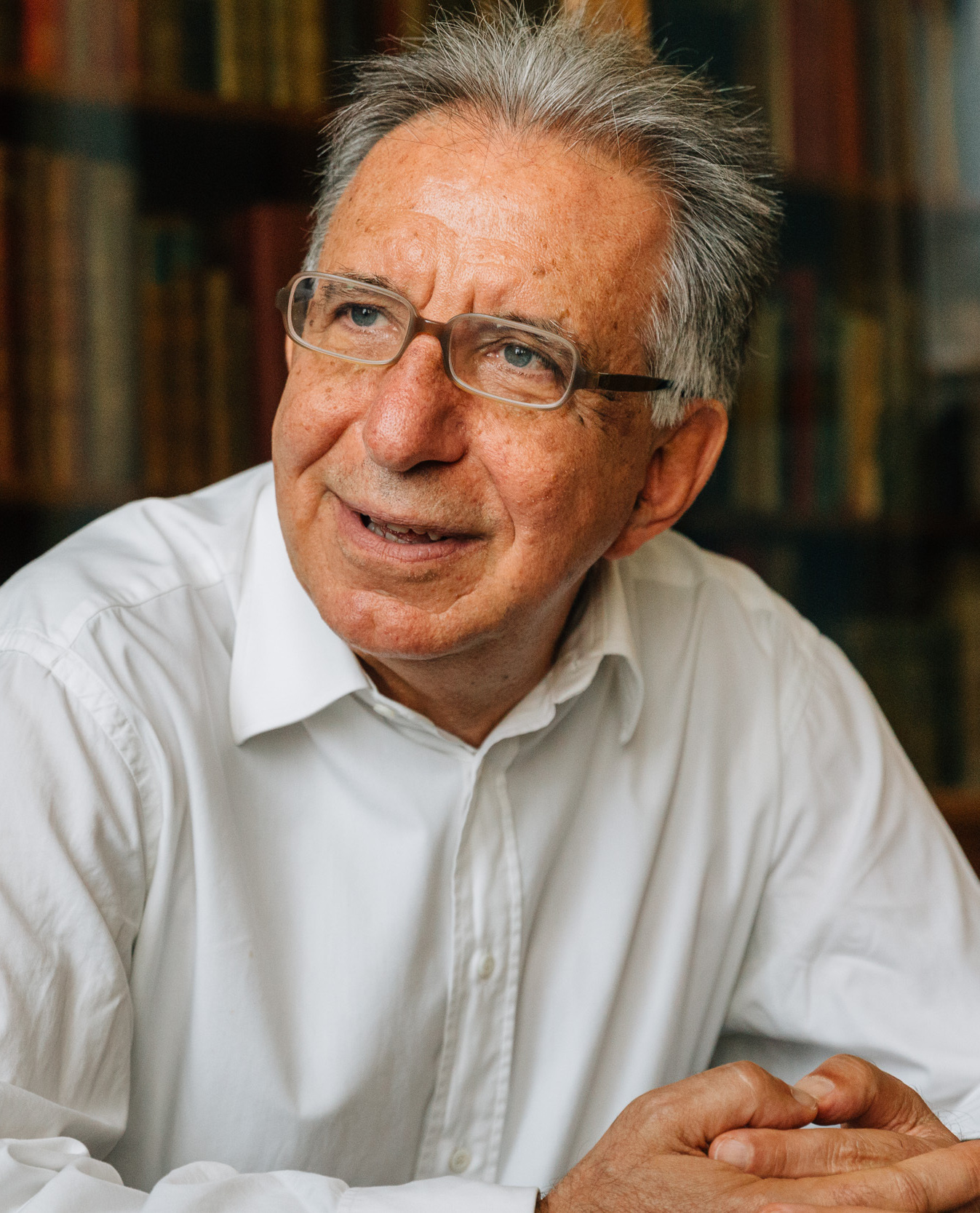
Speaker: Prof. Athanasios Fokas
Dept. of Applied Mathematics and Theoretical Physics, University of Cambridge, UK
Host: Prof. Nikos Logothetis
Biography:
Prof. Athanasios Fokas has a B.S. in Aeronautics from Imperial College (1975), a Ph.D. in Applied Mathematics from California Institute of Technology (1979) and an M.D. from the University of Miami (1986). He also has eight honorary degrees. In 1978 he was appointed a Saul Kaplun Fellow at the Department of Applied Mathematics at Caltech. In the period 1985-1993 he was Professor and Chairman of the Department of Mathematics and Computer Science of Clarkson University. In 1995 he was appointed to a Chair in Applied Mathematics at Imperial College and in 2002 he became the first holder of the inaugural Chair of Nonlinear Mathematical Science at the Department of Applied Mathematics and Theoretical Physics of the University of Cambridge. Since 2015 he has also been an Adjunct Professor of the Viterbi School of Engineering at the University of South California. He held visiting positions at Stanford and Harvard Universities. He is a member of the Academy of Athens and of the three major European Academies, including Academia Europaea. He is a Fellow of the Guggenheim Foundation, of the American Institute for Medical and Biological Engineering, and of the American Mathematical Society. in 2000 he was awarded the Naylor Prize of the London Mathematical Society (the previous recipient was Steven Hawking) and in 2023 the Blaise Pascal Medal of the European Academy of Sciences, “for the Fokas method, which is considered the most important development in the solution of partial differential equations since Fourier, Laplace and Cauchy”. He is the 2024 recipient of the SIAM’s Kruscal Award/Lecture “for his contributions to the development of the inverse scattering transform, for his new method for boundary-value problems, and for his work on the asymptotics of the Riemann zeta function.” He has been awarded the Excellence Prize of the Academy of Athens and the Aristeion Prize of the Bodossaki Foundation. He has been decorated with the Order of Phoenix by the President of the Hellenic Republic. In 2015 he was awarded a Senior EPSRC Fellowship which allowed him for six years to concentrate on his research without any teaching and administrative responsibilities. He has published in a remarkably broad range of topics in Mathematics, Physics, Engineering, Biology, Medicine, Philosophy, and Arts.
Abstract:
The transformative achievements of deep learning have led several scholars to raise the question of whether artificial intelligence (AI) can reach and then surpass the level of human thought. Here, after addressing methodological problems regarding the possible answer to this question, it is argued that the proposed definition of intelligence by proponents of AI as "the ability to accomplish complex goals", is appropriate for machines but does not capture the essence of human creativity. After discussing the differences regarding understanding between machines and the brain, as well as the importance of subjective experiences, it is emphasized that most proponents of the eventual superiority of AI ignore the impact of the body proper on the brain, the importance of the laterization of the brain, and the vital role of the glia cells. By appealing to the incompleteness theorem of Gödel’s and to the analogous result of Turin regarding computations, it is noted that consciousness is much richer than both mathematics and computations. Finally, and perhaps most importantly, artificial algorithms attempt to mimic only the conscious function of parts of the cerebral cortex, ignoring the fact that, not only every conscious experience is preceded by an unconscious process, but also that the passage from the unconscious to consciousness is accompanied by loss of information.
A.S. Fokas, Can Artificial Intelligence Reach Human Thought? PNAS nexus 2, 490 (2023).
A.S. Fokas, Ways of Comprehending, World Scientific (2024).
A.S. Fokas and N.K. Logothetis, Conscious and Unconscious Processes in Vision and Homeostasis, Front. Behav. Neurosci. 19, 1516127 (2025).
A.S.Fokas, The Embodied Brain: Unravelling AI, Medicine, Physics, World Scientific (2026).