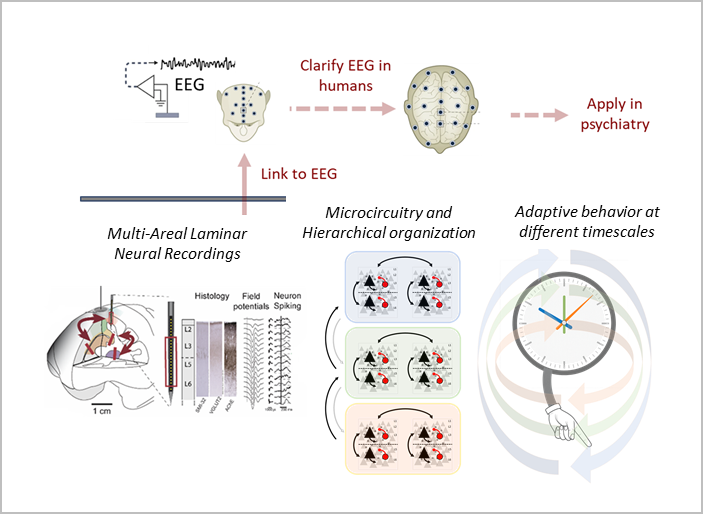
The C³ Lab investigates the neural mechanisms and physiological markers of a core component of cognition: the ability to monitor events and outcomes and flexibly adapt behavior. Imagine taking an action that leads to a negative outcome. You are likely to learn from it so you don't repeat the same mistake. In real life, outcomes unfold across multiple timescales, from immediate consequences of a single action to the slower realization that an entire strategy needs to change. The brain must monitor and integrate this hierarchically, adjusting behavior at the right level and time. This capacity is essential to intelligent agency, and its disruption underlies several mental disorders.
To study this, we combine human EEG and behavioral studies with non-human primate experiments involving Multi-Areal Dense Laminar Recordings and causal manipulations in frontal cortex alongside simultaneous EEG — linking circuit mechanisms to non-invasive biomarkers, from basic neuroscience to Brain-Computer-Interface and mental health applications.